Extra support for Aboriginal and Torres Strait Islander communities
The Australian Government recognises that Aboriginal and Torres Strait Islander Peoples can be more affected by emergencies and disasters like floods, bushfires, pandemics and other severe events. This may be because Aboriginal and Torres Strait Islander Peoples:
- sometimes live in regional and remote areas which are more likely to experience natural disasters
- sometimes have limited access to emergency communications and services
- may use older phones, shared devices or landline phones
- often rely on community-based and local ways of sharing information
- may need information explained through community and local languages.
In emergencies, receiving information early can help protect people, property and the environment. AusAlert sends near‑instant emergency messages to compatible mobile devices like mobile phone, tablets and smart watches.
AusAlert can help Aboriginal and Torres Strait Islander communities:
- prepare, understand and coordinate response to emergencies such as bushfires, cyclones and floods
- share information quickly with family and community members
- understand how soon or serious an emergency is
- receive emergency communications in areas with limited network coverage
- support people who are travelling or away from home.
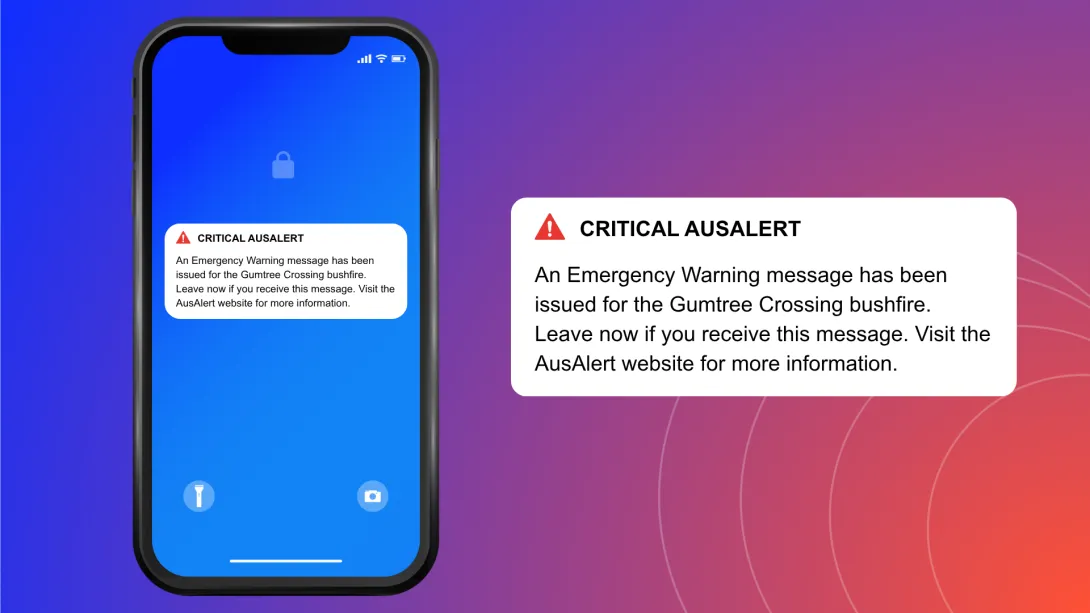
AusAlert messages are sent in English. They will look and sound different to a text message (SMS) and can be delivered with a loud 10-second siren-like sound.
Exactly how it appears will depend on your device type and operating system.
An AusAlert looks something like this:
An AusAlert sounds like this:
Alert sound
In a disaster, you may receive an AusAlert if you have a compatible mobile device.
If you receive an AusAlert:
- read the message carefully
- if needed, ask someone you trust for help
- close the notification to stop the alert
- follow the instructions in the message
- check trusted community and local emergency channels (e.g. ABC Radio) for more information.
Why you can trust AusAlert
AusAlert is run by the Australian Government and is safe and secure. Only authorised emergency services organisations and the Australian Government can send AusAlerts.
AusAlert:
- will never ask for your personal or financial details
- does not know or store your personal information
- does not know or store your phone number
- does not track your location
- does not require you to sign up or download an app.
If you receive anything that seems suspicious, you can report it to ScamWatch.
AusAlert in remote areas
You may still receive an AusAlert even if your phone can’t make calls or send text messages (SMSs) or if it shows ‘emergency calls only’. As long as your phone is within range of a mobile phone tower, the alert can be delivered – even if that tower doesn't belong to your mobile provider.
Mobile phones made before 2019 may not receive AusAlert messages. If you own a phone with a prepaid SIM card, you may still receive an AusAlert, even if you have no data left.
AusAlert won’t replace other ways to stay informed
AusAlert is just one way to stay safe in an emergency.
You should continue to rely on:
- landlines and public phones
- local and community radio news broadcasts
- television
- community leaders and Elders
- health services
- local emergency services
- neighbours, family and community.
It’s important you don’t wait to receive an AusAlert before acting in a disaster.
If you don’t want to receive some AusAlerts
AusAlerts contain life-saving information and are recommended to be turned on to help keep you safe.
If an AusAlert may cause stress or harm for you or someone you care for, you can choose to turn some AusAlerts off or adjust how they appear and sound.
Find out how to turn off an AusAlert.
If you do this, use other sources to stay updated, such as radio, television or ABC online.